
OTTANA
January 16 OTTANA
S’UGOLONE DE Sant’Antoni
The first release of the masks of Boes and Merdules
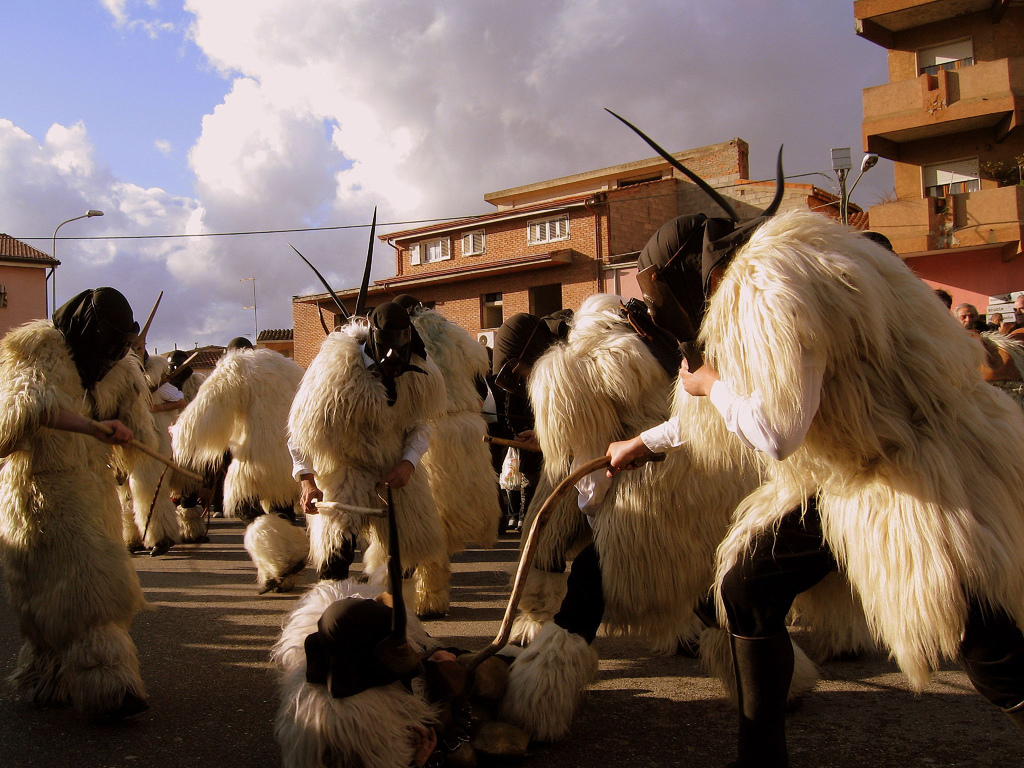
“Son you mask masks, freeing your instincts more ‘hidden …” Vinicio Capossela Ottana Carnival has its roots in ancient times and perpetuates a tradition unbroken, highlighting the past and the cultural identity of the community which has its origins in the agro-pastoral world. masks describe, through spontaneous improvised interpretations that develop in a sort of plot, characters, roles, and the countless situations in the life of the fields, such as plowing, sowing, harvesting, as well as the care, breaking-in, illness, death of the animals. Carnival is one of the most anticipated celebrations of the population ottanese that always participates in a spontaneous and identified in the cultural richness and deep sense of belonging to their culture. The main feature of the Carnival is given by the particular masks de Sos Merdules representing, generically, with this single term, the masks de Sos Boes and other animals, such as: Porcos, Molentes, Crapolos. Carnival that with its masks for three crazy day in the streets of the country, from Quinquagesima Sunday until Tuesday preceding Ash Wednesday, actually begins on the evening of January 16, the feast of St. Anthony the Abbot, when, after the church service that ends with the blessing of the fire (of Ogulone) in the square, the masks make their first release and gather around the fire. was on this occasion that the priest delivery “S’Affuente”, a copper plate embossed with decorative motifs and written in an Alemannic (presumably of Celtic origin), also used during the rites of Holy Week (washing of the feet and put the nails that are removed to Christ on Good Friday at the ceremony of “S’Iscravamentu” deposition from Cross). The dish becomes a musical instrument that struck vertically with a large key sets the beat to dance that Ottana, the ancient “Ballu de S’Affuente.” Other musical instruments are “s’òrriu”, a cylinder of cork with the top covered with a piece of animal skin which hangs from a strap that soaked pitch and slid into his hand, produces a sound hoarse and prolonged that scares the animals and dismounts enemy knights, “of pipiolu “a flute made of reeds. Another significant aspect of the carnival tradition is made up of some food specialties, such as” sas gazzas “of which we have already spoken,” sas savadas “(sweet pastry covered with melted cheese, fried in hot oil and served with honey and / or sugar); “sa pasta violada” (sweet dough kneaded with lard, fried in hot oil), “sas origliettas” (sweet dough thinly sliced strips, fried in hot oil and seasoned with honey. Moreover, “sos culurzones” (ravioli) with cheese and / or cheese, “knows galadina” (jelly pork) and even sausages, ham, bread “carasau ‘cheese


