
GAVOI
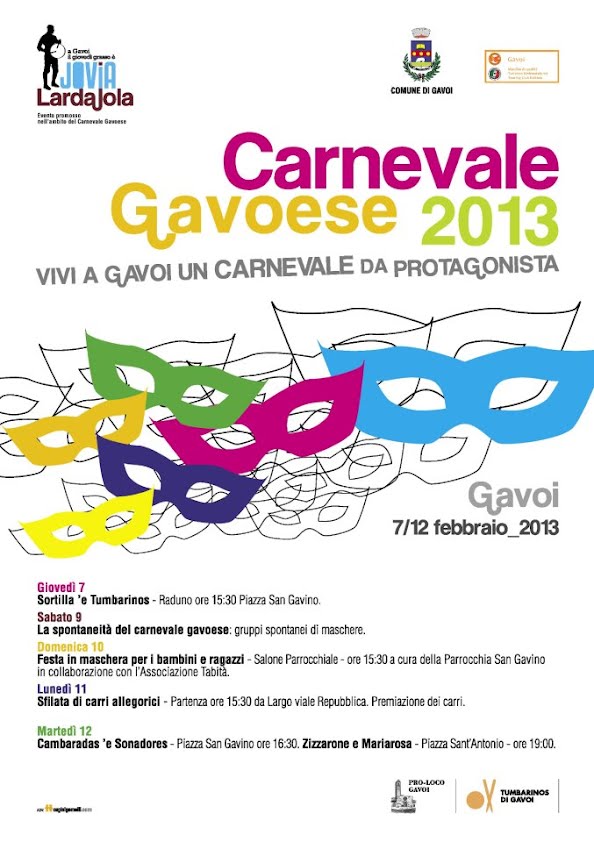
Thursday, February 7, 2013 15:30 Sa Sortilla ‘and Tumbarinos
Gathering at 15:30 Piazza San Gavino, departure parade at 16:30
It is the day that most characterizes the carnival Gavoi, is held on Maundy Thursday “Jovia lardajola” (so named because on this occasion were preparing the beans with lard) and opens the festivities of the carnival. It is a spontaneous gathering of hundreds of people, adults and children, and gavoesi ‘istranzos’, parading through the streets wearing old clothes and velvet shod ‘usinzos’ or ‘Cambales’ or traditional costume Gavoi. Often the face is colored (‘dipped’) in black with coal or covered with masks created with scraps of goat skins used to build sos tumbarinos or other materials such as wood, cork and leather. But what characterizes this day is the music and the presence of the most ancient musical instruments Sardinia: in particular ‘On tumbarinu’, whose presence is attested in Gavoi since 1833 (Casalis), built entirely by hand with goatskins and sheep, using old sieves for flour or old wooden forms once used to produce the cheese pecorino romano (sometimes also uses the cork), “on pipiolu” flute of reeds, “on triangulu”, the triangle in wrought iron; “of tumborro”, string instrument with a bladder made of animal swells, a sort of serraggia. Melodies and rhythms that echo throughout the duration of the carnival. The parade begins in the early afternoon and ends late in the evening with an invitation to sweets like pilicchitos, ruviolos, maraviglias and zipulas. The simplicity of the mask means that the guest is not a simple visitor, but often becomes the protagonist of the event itself, playing traditional musical instruments and wearing old clothes and woolen velvet. The office of euphoria that accompanies the festivities throughout the carnival.
Saturday, February 9, 2013 the spontaneity of the carnival Gavoi
From Saturday evening until the fat tuesday in Gavoi is customary disguise improvising strange characters real and fanciful, using discarded clothes and face in a piece of cloth ‘sa carrot’, similar to a hood with holes for the eyes and mouth , hence the term coring, which indicates the act of dressing up in costume; such groups masks ‘sas cambaradas’ go around from house to house begging pilicchittos, sausages and zeppole.
Sunday, February 10, 2013 15:30 Animation for children
Sunday afternoon will be dedicated to children with activities dedicated to them.
Monday, February 11, 2013 15:30 Parade of floats, and villagers, and related awards
For several years the Monday afternoon there is the parade of floats open to both the country of Gavoi both neighboring countries. The municipal government to encourage the participation held a contest that will award a cash prize for the top three winners and a refund from the 4th to 10th place. At the end of the parade is expected to call the place of sweets.
Tuesday, February 12, 2013 16:30 Cambaradas’ and Sonadores – Fire of Zizzarone and Mariarosa
In keeping with the carnival ends on Shrove Tuesday Gavoi with a gathering of orchestras with instruments of local tradition, composed of young and old.
The parade through the streets of the country will start from Piazza San Gavino and will end in Piazza
St. Anthony the Fire of Zizzarone and Muriarosa.
In fact, on the evening of Shrove Tuesday is customary to say goodbye to Harrasehare Gavoesu On giving to the stake Zizzarone, the puppet of the carnival, with coal as the Wednesday morning the young, “‘Sos Intinghidores or chiniseris” make the sign of the cross the face to the people they meet on the street. This tradition dates back to the early 1930s when the protagonist was “On Mortu and Harrasehare” a very poor man, almost never the place, which lent itself to the carnival in exchange for alms made from house to house. The man, his face blackened with burnt cork was put on a donkey, following talented singers muttos that Gavoi have a verse form different from the usual.
From house to house on “Mortu de arrasehare” was lying on the floor and then improvised muttos on the death of the poor, and as all the members of the host family were accused of his death.
Often muttos were directed towards members of the host family and the theme of the rhyme was very varied.


